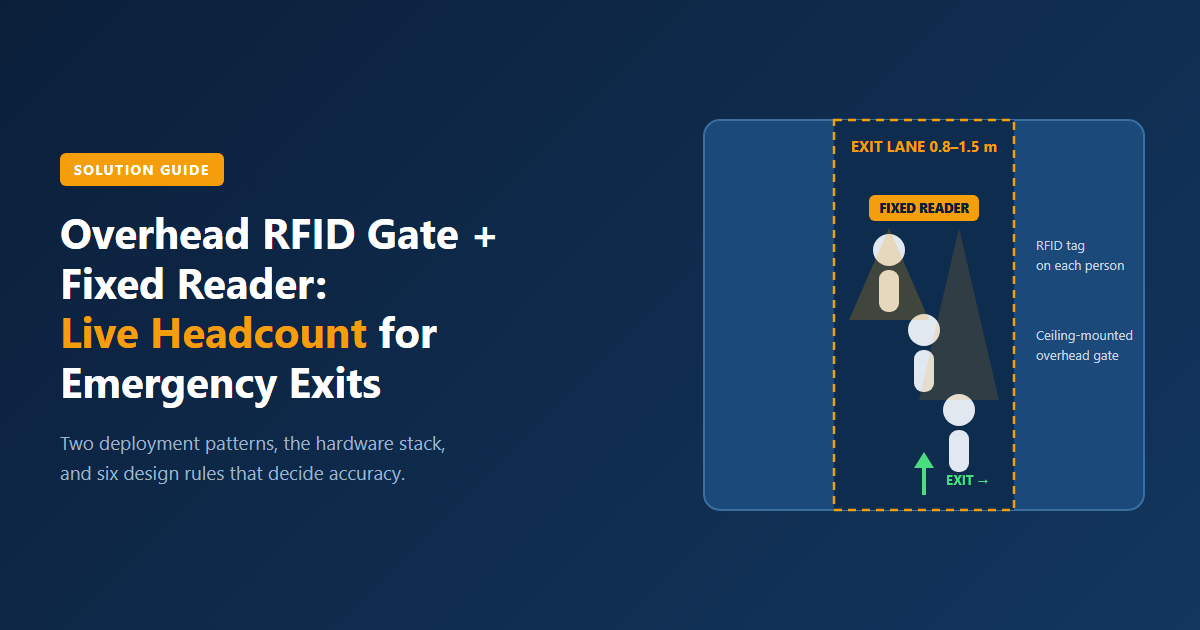
If you manage fire drills, evacuations, or large-venue safety, one number matters more than any other: how many people are still inside the exit route.
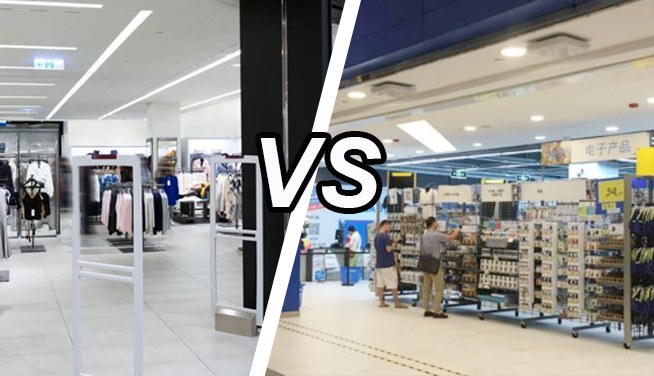
Manual roll call is slow, error-prone, and worst exactly when conditions are worst — smoke, alarms, crowds, and staff who are counting under pressure. Fixed RFID portals solve the accuracy problem, but traditional floor-standing pedestals bring their own issues: they occupy floor space, look obstructive, require invasive installation, and lock you into a fixed lane width.
The good news: you don't need a conventional pedestal gate to get gate-level accuracy. In most emergency-exit projects, there are two better deployment patterns — an overhead (ceiling-mounted) RFID gate, or an RFID antenna + fixed reader portal built onto a frame. Both deliver identification and directional counting, and both fit emergency routes better than a pedestal.
This article covers how each works, the hardware behind them, the design rules that decide whether a deployment succeeds, and where each option stops making sense.
Why emergency exits need a different RFID approach
Emergency routes have constraints that retail loss-prevention gates don't:
|
Constraint
|
What it means for hardware
|
|
The route must stay clear at all times
|
No floor-standing obstacles, no reduced effective width
|
|
Retrofits dominate
|
Core-drilling floors and anchoring pedestals is often impossible
|
|
Aesthetics matter
|
Lobbies, corridors, and exhibition halls can't look like a warehouse checkpoint
|
|
Lane width varies
|
Exit widths range from a single door to a double-width corridor
|
|
Counting, not just detection
|
You need in/out direction and a live occupancy figure, not a pass-event log
|
That last point is where most deployments fail quietly. Counting events is easy. Maintaining a real-time count of people currently in the route requires direction logic — and direction logic depends on antenna placement and read timing, not on reader brand.
Option 1 — Overhead RFID gate: zero footprint, discreet coverage
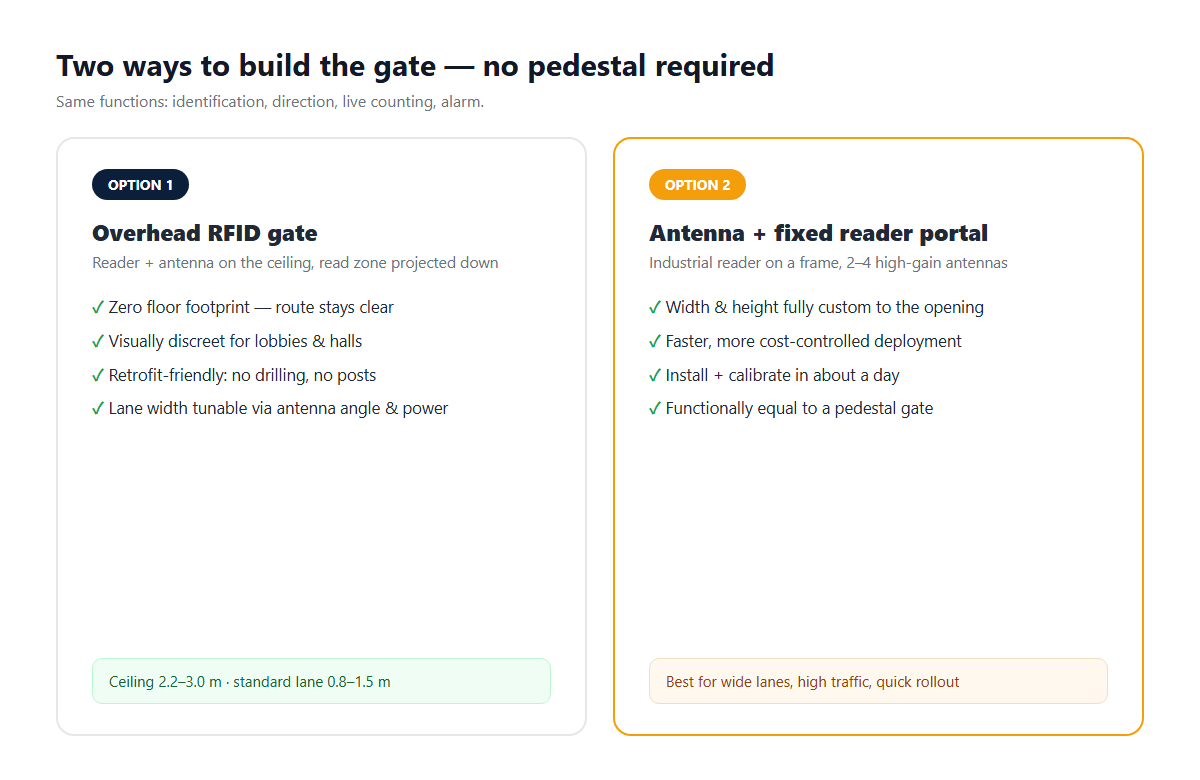
An overhead gate mounts the reader and antenna(s) on the ceiling — either integrated in one housing or split into separate units — and projects a read zone downward. As a person wearing a tag passes through, the system reads the tag and resolves identity and direction.
Where it wins:
-
No floor footprint. The exit route stays completely unobstructed — a decisive advantage in fire-safety inspections.
-
Visually discreet. Suits lobbies, corridors, and exhibition halls where a pedestal would be unacceptable.
-
Retrofit-friendly. No floor cutting, no anchors, no fixed posts — mounting is entirely overhead.
-
Coverage is tunable. By adjusting antenna tilt and output power, a single overhead unit can serve a wider lane than its nominal width.
Practical envelope (typical):
|
Parameter
|
Recommended range
|
|
Ceiling height
|
2.2 – 3.0 m
|
|
Lane width covered
|
0.8 – 1.5 m as standard; wider with antenna tuning
|
|
Mounting
|
Ceiling, integrated or reader/antenna split
|
|
Best fit
|
Corridors, lobby exits, retrofit projects, heritage or finished interiors
|
Where it stops making sense: very high ceilings (above ~4 m), lanes wider than ~2 m, or sites where ceiling access is impossible without major works.
Option 2 — Antenna + fixed reader portal: custom width, fast to deploy
When the lane is wide, the ceiling is unsuitable, or you need something running quickly, build a portal: mount an industrial fixed reader on a frame and connect 2–4 high-gain antennas aimed across the lane or from above, forming a complete read zone.
The frame itself can be steel, acrylic, or timber, sized to the opening. As people pass, the reader activates the tags and reads their codes; the system resolves direction from the read sequence between the entry-side and exit-side antennas.
Where it wins:
-
Width and height are custom — the portal adapts to the doorway, not the other way round.
-
Cost is more controllable than a purpose-built pedestal system for equivalent function.
-
Deploys fast — a frame plus reader plus antennas can be installed and calibrated in a day.
-
Functionally equivalent to a conventional gate: identification, direction, counting, and alarm all included.
Where it stops making sense: narrow finished interiors where a frame would look intrusive, or sites where a visible structure conflicts with the design intent.
Option 1 vs Option 2 at a glance
|
|
Overhead gate
|
Antenna + fixed reader portal
|
|
Mounting
|
Ceiling only
|
Frame — steel, acrylic or timber, sized to the opening
|
|
Floor impact
|
Zero footprint
|
Frame footprint at the lane edges
|
|
Lane width
|
0.8–1.5 m standard, wider with tuning; ~2 m practical max
|
Custom — adapts to wide doorways and corridors
|
|
Ceiling height
|
2.2–3.0 m ideal; ~4 m practical max
|
Per site — not ceiling-dependent
|
|
Deploy speed
|
Fast, no floor works
|
Frame + reader + antennas installed and calibrated in a day
|
|
Best fit
|
Lobbies, heritage or finished interiors, retrofits
|
Wide lanes, high ceilings, fast deployments
|
The hardware stack: reader, antenna, tag
Both options rest on the same three-part architecture.
1. Fixed reader — the system brain
Take the Bowei BRC series access gate as a reference configuration: it integrates a high-speed reader module based on the Impinj R2000 platform with a control module, supports EPC C1 G2 (ISO 18000-6C), offers adjustable output power up to 30 dBm, and handles dense multi-tag populations.
In infrared-trigger mode, the reader activates only when a person is detected crossing the threshold. This is what keeps the power budget low and the invalid reads out — and it's where a missed-read rate below 1% is achievable in a properly tuned lane. (Treat that figure as a tuned specification, not a plug-and-play guarantee: it depends on tag placement, antenna angle, and lane geometry.)
2. RFID antenna — the coverage shaper
Narrow-beam, high-gain antennas are the difference between a clean lane and a noisy one. They concentrate energy inside the passage and keep it away from the corridor, the adjacent lane, and the stack of tags sitting 3 m away in an office.
-
Overhead pattern: ceiling antennas aimed downward.
-
Portal pattern: directional antennas on both sides, or above, angled into the lane.
3. RFID tag — the identity layer
Each person under management carries a badge, wristband, or lanyard tag holding a unique code. Two selection notes matter more than most spec sheets admit:
-
Choose human-body-tolerant tags. UHF energy is absorbed and reflected by water — and people are mostly water. A tag that performs on a pallet may not perform on a chest.
-
Fix the tag's orientation. A tag that swings freely reads inconsistently; a badge worn flat and consistently is worth more than a higher-sensitivity tag worn loosely.
From read events to a live occupancy count
This is the part that determines whether the system is useful in an evacuation.
The platform compares read timing between the entry-side and exit-side antennas. An entry increments the count; an exit decrements it. The output is not "312 passes today" — it's "17 people currently inside the route."
Data moves to the central management platform over RS232 or RJ45 in real time. At the assembly point, a reader scans the tags of arriving personnel and uploads their presence, and the platform reconciles that list against the expected roster. Anyone not present at the assembly point triggers an alert automatically. The same data stream produces transit logs and reports — entry and exit times, direction, identity — which is exactly what a drill evaluation or a compliance audit asks for.
Six design rules that decide success
Deployment details matter more than datasheet numbers. From field practice:
|
#
|
Rule
|
Why it matters
|
|
1
|
Keep the lane at 0.8–1.5 m
|
Up to 2.2 m is possible, but accuracy degrades gracefully rather than linearly — test before committing to a wide lane
|
|
2
|
Respect the mounting envelope
|
2.2–3 m ceiling height for overhead units; portal height per site
|
|
3
|
Use infrared triggering
|
Cuts power draw and invalid reads; prevents the reader from counting the same person repeatedly
|
|
4
|
Specify body-tolerant tags
|
The single most common cause of "missed reads" in people-counting projects is tag choice, not reader power
|
|
5
|
Tune power and angle against adjacent lanes
|
Cross-lane reads are the most frequent failure mode in multi-lane sites
|
|
6
|
Test with real people, not test tags
|
A rack of tags in a meeting room will always outperform reality — walk 20 people through the lane, in both directions, in a crowd
|
Typical applications
-
Industrial parks and factories — live headcount per emergency exit during drills and evacuations
-
Exhibition halls and arenas — automated entry/exit statistics with alerts on irregular passage
-
Universities and office campuses — attendance and evacuation management on one platform
-
Public buildings — fast roll call during fire drills and unplanned incidents
Why Bowei Intelligent
Shenzhen Bowei Intelligent Identification Technology Co., Ltd. (Bowei RFID) is a Chinese national high-tech enterprise and a member of the RAIN RFID Alliance, with in-house R&D and manufacturing across RFID antennas, tags, and access-gate systems.
On the software side, Bowei applies deep-learning AI to gate read data to tighten accuracy in dense, fast-moving pedestrian flows. For emergency-exit projects, Bowei supplies the complete chain — overhead gates, antenna-plus-reader portals, tags, and the management platform — with custom integration and on-site deployment support. The same hardware family is deployed in logistics, warehousing, library and archive management, and personnel attendance systems.
FAQ
-
Do I need a traditional pedestal gate to count people at an exit?
-
No. An overhead gate or an antenna-plus-fixed-reader portal provides the same identification, direction, and counting functions, usually with better fit for retrofits and wider lanes.
-
How accurate is the counting?
-
In a properly tuned lane using infrared triggering, a missed-read rate below 1% is achievable. Accuracy depends on tag placement, antenna angle, lane width, and pedestrian density — always validate with a live walk-through test.
-
Can it tell me how many people are still inside, not just how many passed?
-
Yes. Direction is resolved from the read sequence between entry-side and exit-side antennas, so the platform maintains a live in-route occupancy count rather than a cumulative pass count.
-
Does it work without network connectivity?
-
Local reading and counting continue at the edge; syncing to the central platform and roster reconciliation require the network link.
-
Can it integrate with an existing access-control or attendance system?
-
Yes — data is exposed over standard interfaces (RS232 / RJ45), and integration scope is defined per project.
Planning an emergency-exit counting project? Tell us your lane width, ceiling height, expected pedestrian flow, and whether the site is a new build or a retrofit — we'll come back with a deployment recommendation and a hardware list.