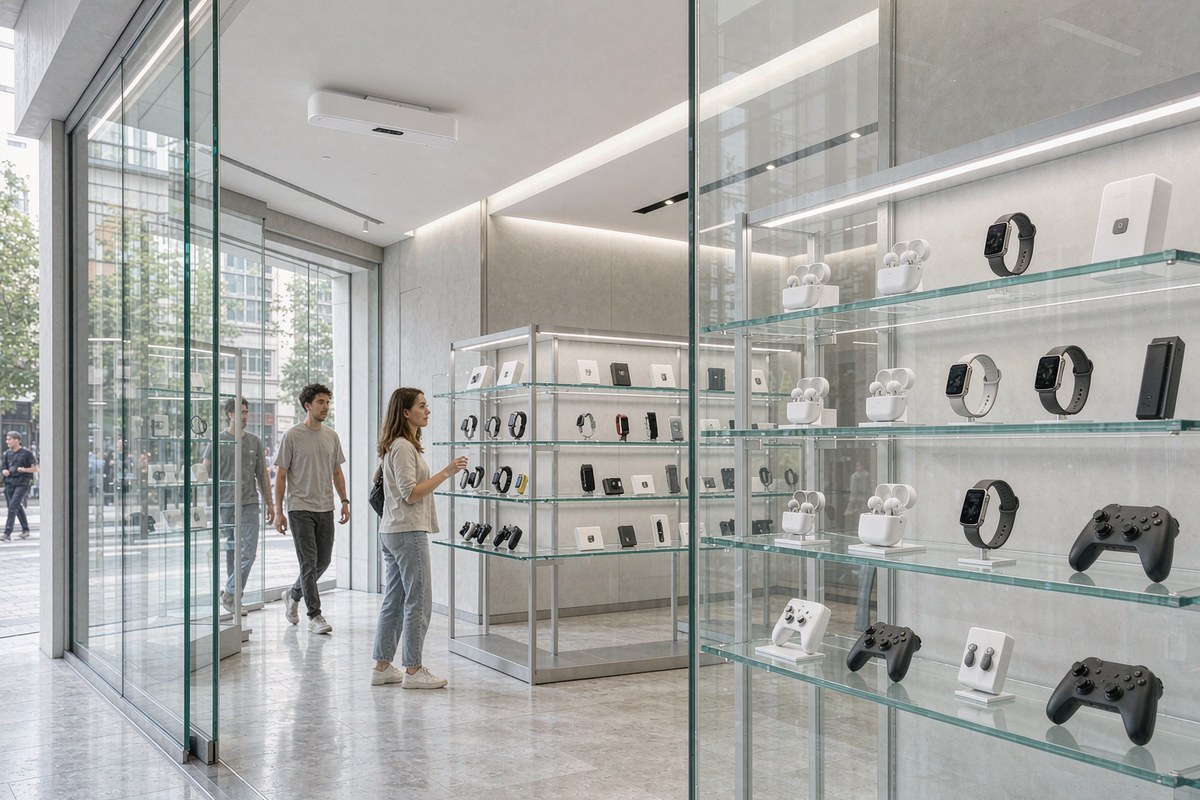
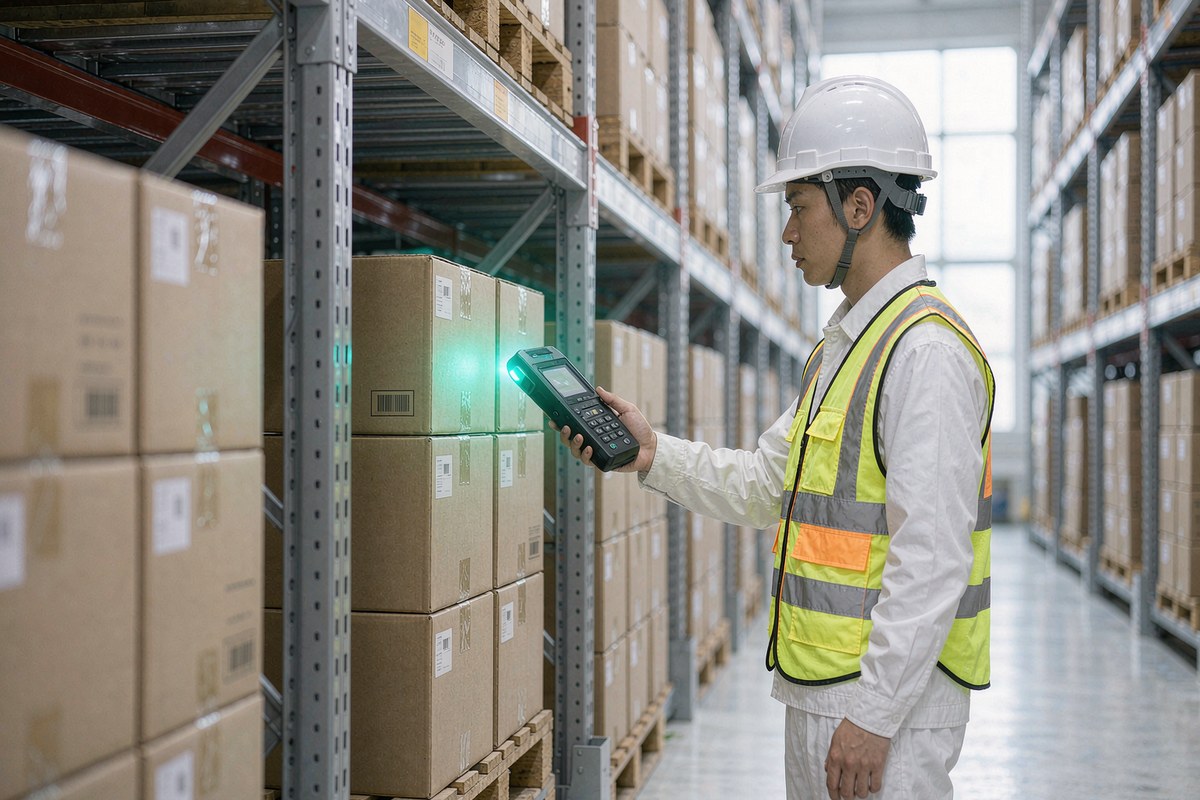
When choosing an anti-theft entrance system for retail stores, libraries or archives, UHF RFID security gates and traditional EAS systems are the two most representative technology routes. Many managers' first reaction is to compare price: EAS costs less upfront, while RFID requires a higher initial investment. But if the decision stops at the initial budget, you may miss far greater long-term operational value.
Based on years of industry experience in RFID hardware, BOWEI presents a practical comparison across four dimensions — working principle, functionality, cost structure and best-fit scenarios — to help you make a smarter choice.
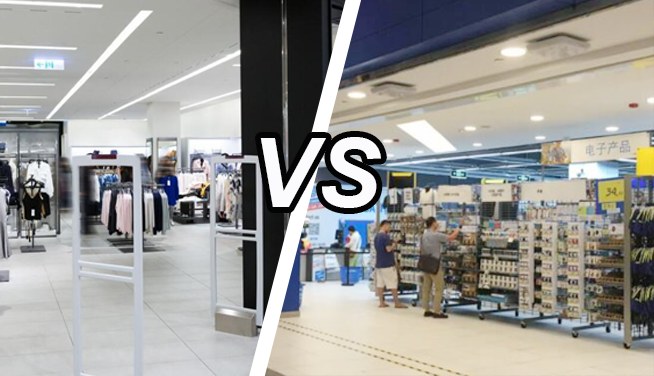
1. Working Principle: From "Detection" to "Precise Identification"
1.1 Traditional EAS: Binary "Presence" Detection
EAS (Electronic Article Surveillance) works on a simple principle: detect whether a signal is present. Transmitting and receiving antennas at the exit continuously monitor a specific frequency. When a product carrying an active (non-deactivated) EAS label passes by, the label resonates with the antenna, the signal strength changes, and the alarm triggers.
Common EAS technologies include acoustic-magnetic (AM, typically 58/68 kHz, based on tuning-fork resonance), radio frequency (RF, 8.2 MHz, based on LC resonance) and electromagnetic (EM, 10 Hz–20 kHz, magnetic-strip detection). Whatever the technology, the nature is the same — a binary judgment. It can only tell you that "an unauthorized label passed through", never which product, which category or at what time.
1.2 UHF RFID Gates: Smart Screening with a Built-in "ID Card"
UHF RFID gates operate on the international ISO 18000-6C (EPC Gen2) protocol in the 920–925 MHz band. The key difference: every product carries an RFID tag storing a unique EPC code — the product's "digital ID card" — plus a dedicated EAS status bit.
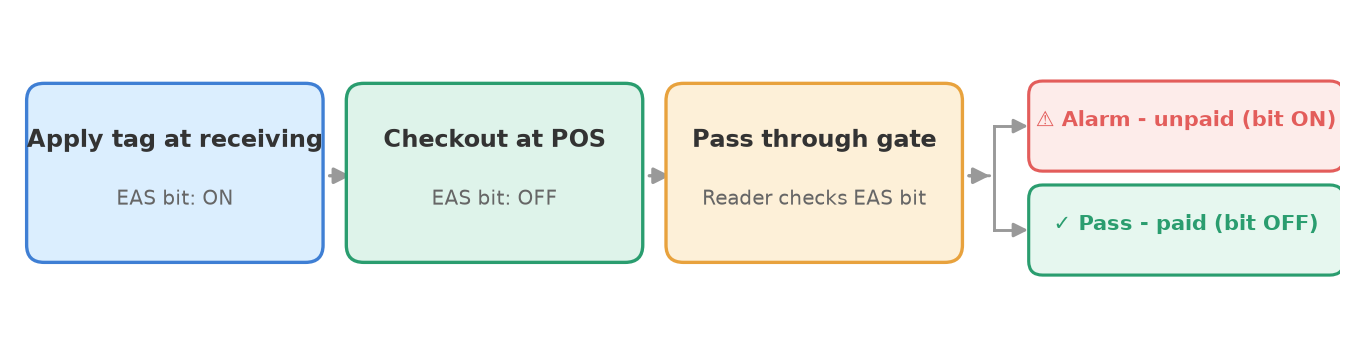
The workflow is intelligent end to end. Tags are applied at goods receiving with the EAS bit set to "on". At checkout, the POS reader automatically rewrites the bit to "off". When a product passes through the gate, the reader checks the EAS status: only items still flagged "on" trigger the audio-visual alarm. In other words, an RFID gate doesn't just know that "an unpaid item left the store" — it knows which garment, what size, what color, through which gate, at what time. That information becomes valuable material for analytics and operational optimization.
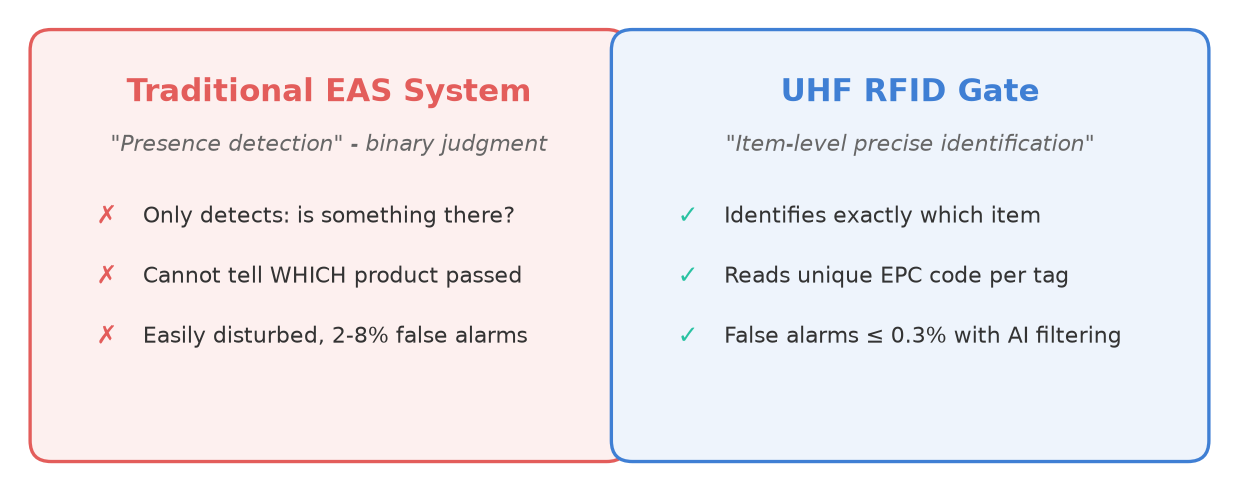
2. Functionality: From Anti-Theft Only to Integrated Management
The functional gap goes far beyond "item-level identification".
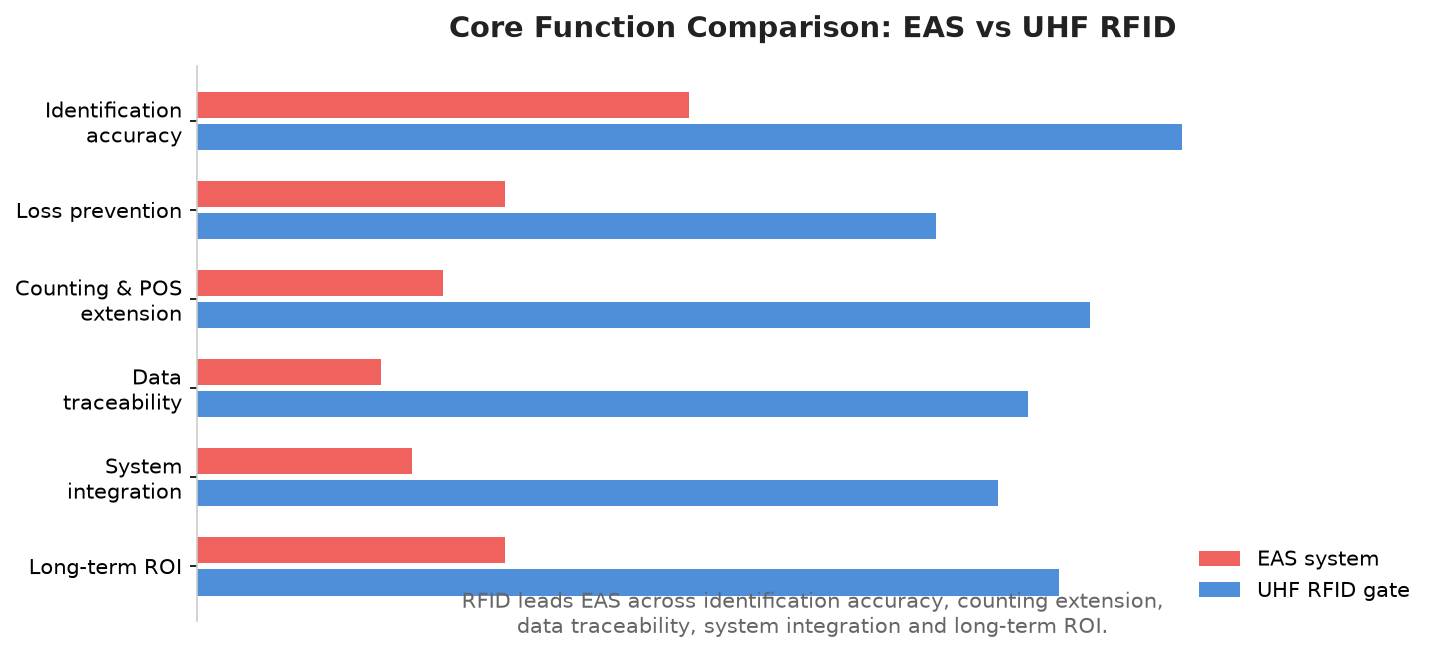
Identification: RFID gates perform item-level identification, reading 200+ tags simultaneously in the gate zone, with a whitelist mechanism — paid items pass without false alarms. EAS only detects signal presence, is easily disturbed by the surrounding electromagnetic environment, and typically produces false alarms at a rate of 2–8%. A quality RFID gate with AI algorithm filtering keeps false alarms below 0.3%.
Tags: EAS soft and hard labels must be deactivated or removed at checkout — they are one-time consumables, permanently dead once killed. RFID tags support a reusable mode: just rewrite the EAS bit, the tag stays intact, and it can continue serving inventory counting and logistics tracking. Over the long run, that's a significant cost advantage.
Extensibility: EAS is a pure anti-theft tool — standalone, hard to integrate with POS, WMS or ERP. RFID gates are born with data interfaces: they connect seamlessly to POS, WMS and ERP, making product movement traceable across the whole chain. Combined with handheld RFID readers, stores gain bulk inventory counting, fast batch checkout, and inventory accuracy improvement from 87% to over 99.5% — added value EAS simply cannot offer.
3. Cost Analysis: Initial Investment vs. Long-Term Return
Take a 100 m² apparel store as an example.
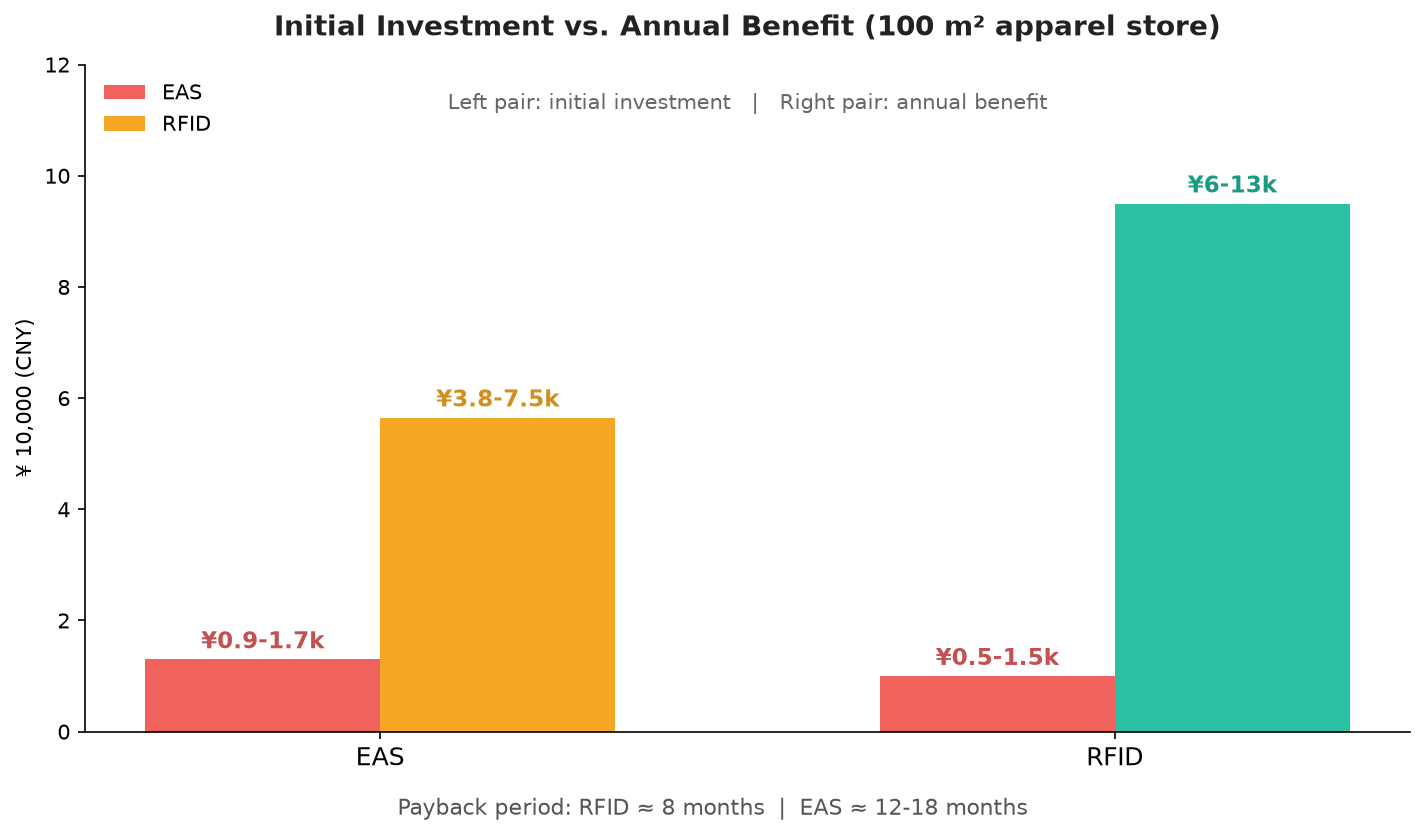
Initial investment: An RFID solution includes gate equipment (¥20,000–40,000), annual reusable tag supplies (¥5,000–10,000), a handheld counting device (¥5,000–10,000), software (¥5,000–10,000) and installation (¥3,000–5,000) — about ¥38,000–75,000 (~USD 5,300–10,500) in total. An EAS solution needs only gate equipment (¥5,000–10,000), one-time soft labels (¥3,000–5,000) and simple installation (¥1,000–2,000) — about ¥9,000–17,000 (~USD 1,300–2,400). Upfront, RFID costs 3–4 times more.
But the gap in annual returns is far wider. RFID benefits stack up: counting efficiency saves roughly ¥30,000–50,000/year in labor; shrinkage drops by about 60%, saving ¥10,000–30,000/year; inventory accuracy jumps from 87% to 99.5%, cutting stockout losses by ¥20,000–50,000/year; inventory turnover improves about 33%; faster checkout improves peak-hour customer experience. Total annual benefit: ¥60,000–130,000 (~USD 8,400–18,000). EAS delivers anti-theft only, worth about ¥5,000–15,000/year.
So the payback picture reverses. Despite the higher upfront cost, RFID's annual return is 5–10 times that of EAS, with an actual payback period of about 8 months; EAS needs 12–18 months. From a full life-cycle perspective, RFID is the better investment.
4. Selection Guide: There Is No "Best", Only "Most Suitable"
4.1 When EAS Is Still a Sensible Choice
-
Budget is very limited and only basic anti-theft is needed
-
The store is small, with no inventory management or data analytics needs
-
Simplest possible deployment, no time for antenna and parameter tuning
-
Temporary venues and pop-up stores as a short-term measure
4.2 When RFID Gates Are the Better Fit
-
You value long-term development and want anti-theft, counting, checkout and data traceability in one integrated system
-
You run chain stores that need a unified product data platform and remote monitoring
-
You want efficient counting and accurate inventory to reduce stockouts and improve capital turnover
4.3 Industry Reference
Apparel retail chains are the classic beneficiary of RFID gates — anti-theft + counting + checkout in one, with impressive ROI. Libraries and archives integrate anti-theft, self-service borrowing/returning and collection counting. Jewelry and luxury stores need item-level tracking for high-value goods — RFID's advantage is clear. For convenience stores and supermarkets, it depends on scale: small stores can use EAS, while large supermarkets and warehouse clubs should adopt RFID. In warehousing and medical consumables, RFID gates don't just prevent theft — they automatically record goods movement and expiry dates.
5. A Smooth Migration Path from EAS to RFID
Stores already running EAS don't have to tear everything out overnight. We recommend a four-phase transition:
-
Pilot (1–2 months): Install RFID gates plus a handheld counting device in one flagship store, running alongside the existing EAS.
-
Validate (3–6 months): Collect pilot data, evaluate real improvements in counting efficiency, shrinkage and inventory accuracy, and refine the workflow.
-
Roll out (6–12 months): Replicate the proven solution to other stores; EAS keeps protecting legacy-labeled products meanwhile.
-
Switch (12–18 months): Once most products carry RFID tags, remove the EAS equipment and go fully RFID.
Throughout the migration, old and new systems coexist: EAS covers old-labeled products, RFID handles new tags. After one normal sales cycle (about 3–6 months), old inventory sells through naturally and the transition completes itself.
6. FAQ
Q1: Can RFID gate false alarms really stay below 0.3%?
Yes — but it takes three things working together: quality hardware, scientific deployment and AI algorithm filtering. The BOWEI BRC-04 series gate readers with our self-developed AI algorithm have been extensively field-tested, with false alarms stably below 0.3%, reducing customer disruption and manual intervention.
Q2: How much more expensive are RFID tags than EAS labels?
RFID tags cost about ¥0.3–1 each; EAS soft labels about ¥0.05–0.2. But RFID tags can be printed directly onto hang tags as one piece, and the reusable mode (rewrite the status bit, never damage the tag) makes the long-term cost lower.
Q3: Do metal and liquid products affect RFID gates?
Yes — metal and liquids shield and absorb UHF signals. For canned drinks or cosmetics with metal packaging, use anti-metal tags or add an isolation layer between the tag and the metal surface to ensure normal reading.
Q4: Can an RFID gate identify multiple items at once?
Yes. UHF RFID gates read 200+ tags simultaneously, and with advanced anti-collision algorithms, even several customers carrying multiple items through the gate at once are read accurately — no missed reads, no cross-reading.
Q5: What happens to EAS labels on old products after switching to RFID?
Nothing special — EAS labels on existing products are simply deactivated at checkout as usual, while all new incoming products carry RFID tags. After one complete sales cycle (usually 3–6 months), old stock sells through and the labels exit naturally. The whole process is smooth.
7. Summary
|
Dimension
|
UHF RFID Gate
|
Traditional EAS
|
|
Core positioning
|
Anti-theft + counting + management in one
|
Anti-theft only
|
|
Best fit
|
Chain retail, libraries, warehousing, healthcare
|
Small stores, temporary deployment
|
|
Initial investment
|
Higher (¥38,000–75,000)
|
Lower (¥9,000–17,000)
|
|
Annual benefit
|
¥60,000–130,000
|
¥5,000–15,000
|
|
Payback period
|
About 8 months
|
About 12–18 months
|
|
Trend
|
AI integration, continuously evolving
|
Mature technology, slow iteration
|
In short: if you aim at long-term development and integrated management capability, RFID gates are the more forward-looking choice; if you only need basic anti-theft under a tight budget, EAS still does the job. BOWEI provides the full chain of services — RFID gate hardware, antennas, readers, solution design, deployment and commissioning — and we are glad to evaluate your scenario and offer customized recommendations. Contact us for a free consultation →