As warehousing and logistics accelerate their shift toward digital, intelligent operations, the efficiency and accuracy of inbound and outbound processing directly affect operating costs and customer satisfaction. More and more warehouse managers are turning to UHF RFID technology - and in particular the "directional antenna + reader" gate solution, which is becoming standard equipment for modern smart warehouses thanks to its outstanding batch identification and precise control.
Yet a core requirement comes up in almost every selection discussion: reading one hundred-plus tags in a single pass - fast, accurate, error-free. Behind this seemingly simple need lie antenna selection, gate deployment and anti-collision algorithms. This article breaks down the key logic.

Manual box-by-box handling is giving way to gate-level batch identification in modern warehouses.
1. Why the Directional Antenna Is the "Precision Eye" of Warehouse Inbound and Outbound
In an RFID gate system, the antenna determines signal coverage, direction and strength. In warehouse inbound/outbound scenarios, goods pass the gate as whole pallets or cartons - tags are dense and goods are stacked. An omnidirectional antenna spreads signal in all directions and easily misreads tags on shelving flanking the aisle, causing cross-reads.
The core value of a directional antenna is "hitting exactly where it points." By controlling the phase and amplitude of antenna elements, it forms a narrow-beam electromagnetic field that constrains the RF signal precisely within the passage area covered by the gate, eliminating misreads of shelf tags - only the tags of goods actually passing through the gate get identified.
Concretely, directional antennas bring three advantages to warehouse gates:
First, precise coverage, no cross-reads. A narrow-beam circularly polarized antenna deployed at the gate confines signal strictly within the channel width, so shelf tags on both sides are never misread. This matters greatly in high-density shelving warehouses - avoiding the awkward situation of "goods inside the gate not yet finished reading, while the shelf outside already reported its numbers."
Second, stable long-range reading. Directional antennas have higher gain, ensuring higher radiated power density in the target direction at the same input power. Even with a channel 2.5 to 3 meters wide, goods passing anywhere within the channel are identified stably, with no blind zones.
Third, dynamic batch identification. Whether goods move by forklift or pallet truck, as long as they pass the gate area in one go, the high-gain identification field captures all tag data within the 1-3 seconds of passage - enabling "no stopping, no unloading" batch inbound and outbound.
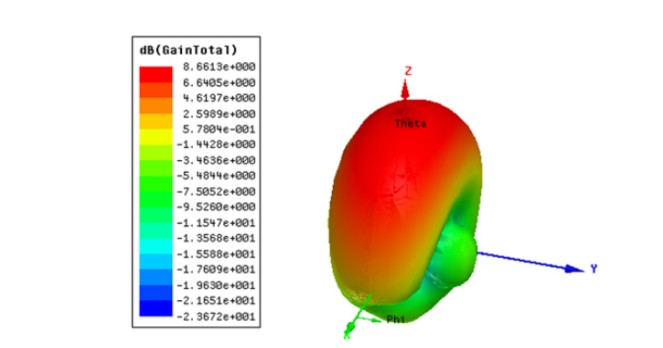
3D radiation pattern of a directional antenna: energy concentrated in a controlled lobe toward the passage.
2. The RFID Gate: The Workhorse for Reading a Hundred Tags in One Pass
With the directional antenna as the "precision eye," the system still needs a strong "execution hub" - the RFID gate. Integrating readers, antenna arrays and sensing controls, gates are typically deployed as portal frames at warehouse entrances and exits. When tagged goods pass through, the system identifies tags automatically, quickly and in batch - no manual barcode scanning. How does it read one hundred-plus tags in a single pass? Three core technologies:
1. UHF batch identification. Warehouse scenarios use UHF RFID (860-960 MHz). Readers in this band can read 200+ electronic tags in a single scan, at up to 600 tags per second. UHF identification needs no close-range aiming - it automatically reads every tag in range. A pallet stacked with over a hundred cartons passing the gate is fully identified within the 5 seconds a forklift takes to drive through, with data written directly into the warehouse management system.
2. Spatially diverse antenna arrays and anti-collision algorithms. Gates deploy multiple directional antenna groups on top and sides, forming a three-dimensional scanning net. Even with dense stacking or metal shielding, multi-path signal compensation keeps read rates high. Professional gates also carry strong anti-collision algorithms and antenna phase adjustment, tuning beam angles and field strength to overcome metal and liquid interference. In concurrent multi-tag scenarios, dynamic beamforming and anti-conflict algorithms ensure zero missed reads even with dense tags.
3. Touchless automatic capture with direction judgment. An infrared sensing trigger activates scanning automatically when a forklift or AGV enters the gate coverage area - no manual intervention. Professional gates embed phased-combination antennas and positioning algorithms that precisely judge tag movement direction, accurately distinguishing "inbound" from "outbound." This fundamentally eliminates inventory errors caused by mixing up entries and exits.
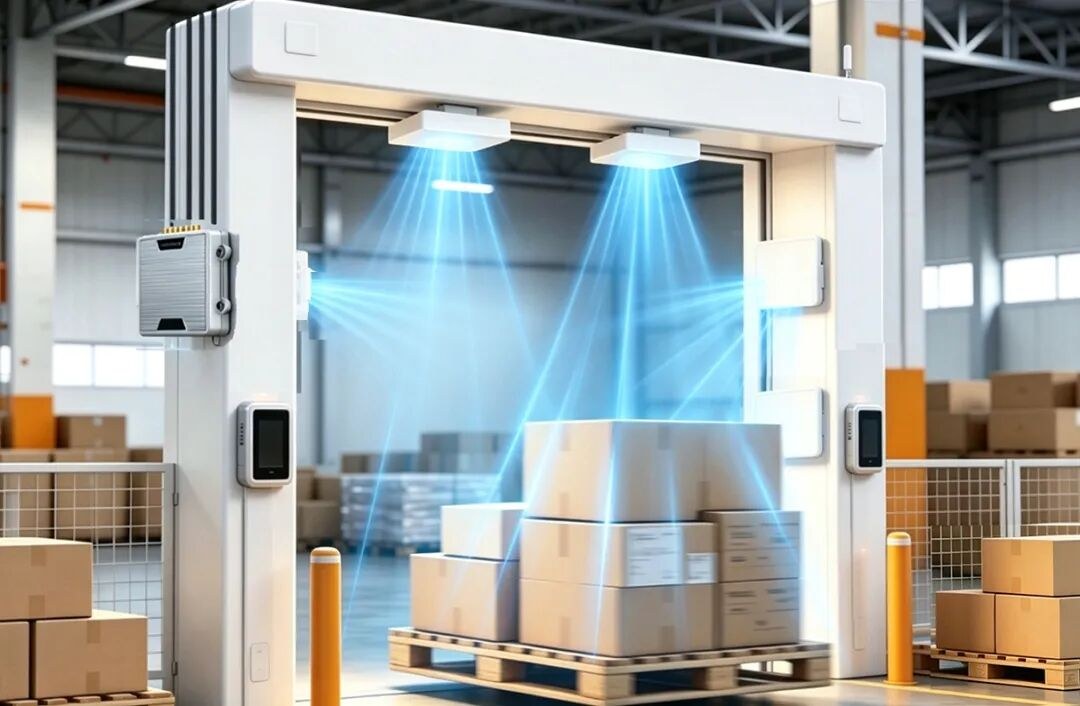
An RFID portal gate captures a full pallet of cartons in seconds - no stopping, no unloading.
3. BOWEI: A Professional Provider of RFID Gates and Directional Antennas
Deep technical accumulation and scaled delivery capability are rare in the RFID hardware field. Shenzhen Bowei Intelligent Identification Technology (BOWEI) is a national high-tech enterprise integrating R&D, manufacturing and sales of RFID antennas, with a rich product line and mature industry solutions in RFID gates and directional antennas.
Guided by the strategy of "requirements lead applications, applications drive products," BOWEI provides full-line hardware selection - from anti-metal specialty tags to industrial fixed readers, RFID gate portals and handheld terminals - matched to your SKU scale, warehouse conditions and workflow, with seamless integration into WMS/ERP systems. After deploying BOWEI's solution, one large retail warehouse achieved automatic recording across inbound, shelving, picking and outbound, with 70% less manual stocktaking effort and 99.9% data accuracy.
Conclusion
From manual barcode scanning to RFID gate batch identification, the efficiency revolution in warehouse inbound and outbound has arrived. Directional antennas solve "precise coverage, no cross-reads"; gates solve "batch reading, fast passage" - together they are the key path to reading a hundred tags in a single pass and dramatically improving throughput.
If your warehouse suffers from slow inbound/outbound, lengthy stocktakes and error-prone data, start with the combination of RFID directional antennas and gate portals - and make every movement of goods precise, efficient and traceable.
Ready to upgrade your warehouse gates? Contact BOWEI for a free site assessment and deployment plan.