Core conclusion: the competitive dividing line for RFID in 2026-2027 is not "reading farther" but "whether the device has edge AI judgment" and "whether the vendor can deliver scenario-level read accuracy." China's nine government departments have listed passive IoT as a key R&D direction in the IoT Industry Innovation Action Plan (2026-2028) and called for deep integration of AI, edge computing and IoT terminals. China's RFID market is expected to exceed RMB 68 billion (about USD 9.5 billion) in 2026, growing at over 18% per year; the global market stands at USD 18.66 billion with an 11.52% CAGR through 2031. The five directions below are ranked by their impact on purchasing decisions.

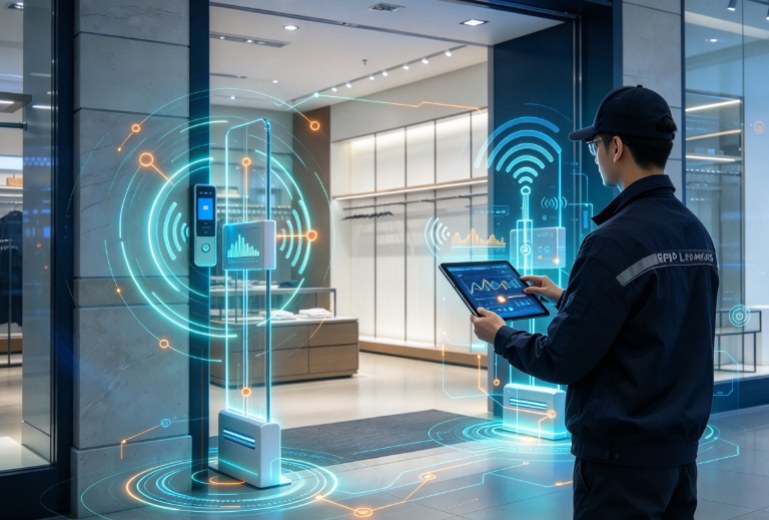
RFID and AI converge: store entrances and warehouse aisles become one intelligent sensing network.
Direction 1: AI Moves onto the Device - From "Reading Tags" to "Judging Intent"
In a nutshell: the key change in 2026 RFID gates is that the terminal runs trajectory-recognition algorithms locally, completing entry/exit direction judgment and false-alarm filtering on the device with a false-alarm rate down to 0.3% or lower, without cloud round-trips. To judge whether a gate has this capability, check whether it supports edge algorithms + OTA upgrades - not just read distance.
Traditional RFID gates trigger on "tag with EAS bit set detected," and cannot distinguish a customer lingering to try on clothes from one actually leaving with merchandise. The phase-switching technique works like this: the antenna dynamically switches its transmission phase 10-50 times per second, creating a phase-gradient field across the channel. The direction is judged from the signal sequence as a tag crosses successive phase zones, with multiple samples taken within the 0.5-1 second a tag takes to pass. BOWEI's phase-switching solution integrated into its gate antennas has measured false alarms dropping from the traditional 5-12% to 0.3% or lower, with a direction-judgment accuracy above 99% read rate for 50+ fast-moving tags in a 2.2-meter channel.
Where it applies: this capability is most valuable for direction-sensitive scenarios such as retail loss prevention and warehouse entrances. For simple inventory checks that only need "is it in the zone," edge AI is not essential. Buyers should distinguish "genuinely need direction judgment" from "paying a premium for a trendy capability."

Edge AI on the gate: a phase-gradient field judges direction and filters false alarms locally, in under a second.
Direction 2: Passive IoT Becomes a National Technology Direction - Where Is the Incremental Space?
In a nutshell: passive RFID tags need no battery, cost well under one yuan (below USD 0.05) and last 5-10 years, making them the most realistic carrier for the government plan's "hundreds of millions of connections" target. But the opportunity is not in total volume - it is in the structural penetration gap: item-level RFID penetration in China is roughly 10% for apparel, 4% for footwear, and only 0.1% for individual parcels, while tote bags and pallets already reach 72%.
The plan sets a goal of breaking RMB 3.5 trillion (about USD 490 billion) in core IoT industry scale by 2028 and cultivating 10 application areas with hundreds of millions of connections. In 2026 the global price of a UHF tag inlay has fallen below RMB 0.3, with about 55 billion units shipped per year; the UHF band holds a 61% share of the RFID market and grows at 18.7% - direct evidence that passive IoT is scaling.
What it means for buyers: the low-penetration segments (apparel items, footwear, item-level parcels) are the battleground for solution providers over the next 2-3 years. At this stage, a hardware supplier's production consistency and batch stability carry more long-term weight than price differences alone.

Passive RFID scales across footwear, apparel and parcels - the biggest penetration gaps are the biggest opportunities.
Direction 3: How Does RFID Data Enter the AI Analytics Loop?
In a nutshell: the daily stream of "entry/exit, dwell, pick-up" events from RFID is turning from a mere alarm trigger into fuel for retail AI. But data value depends on event granularity from the hardware - the ability to distinguish direction, dwell duration and pick/return actions, not just "tag present."
Three closed loops are already operational:
-
Fitting-room sensing x sales data = fitting conversion rate: for assortment and display decisions - provided the fitting-room reader reliably distinguishes "taken in" from "taken out."
-
Gate traffic x inventory data = stockout prediction: for automatic replenishment triggers - provided the gate's direction accuracy is high enough, otherwise replenishment signals are polluted by false alarms.
-
Pick-up behavior = traffic heatmaps: for store layout optimization - provided shelf-level read zoning is fine-grained enough.
The vendor's role is changing: RFID suppliers now deliver not just "reading devices" but "sensing data entry points that business systems can call." When purchasing, confirm whether the device's data interface is open and whether its event format can connect to your existing BI/ERP - rather than only comparing read distance and unit price.

Sensing data flows into the AI loop: fitting conversion, replenishment alerts and layout analytics on one dashboard.
Direction 4: Three Verifiable Hardware Leaps
In a nutshell: effective hardware progress through 2027 concentrates in three areas: dynamic antenna tuning (debug-free operation around metal), higher concurrent anti-collision throughput (stable at the 500-tags-per-second class), and more sensitive chips (stable reading through thick clothing and liquids). Of the three, real-world anti-collision throughput is strongly environment-dependent, so vendor claims must be verified on site.
Theoretical anti-collision peaks can exceed 1,000 tags per second, but actual throughput in warehouse/retail environments typically falls in the 200-700 reads-per-second range, influenced by tag density, reader sensitivity and multipath effects. A claimed "500+ tags/second" should be read as a reference value under ideal conditions; purchase decisions should be based on on-site pilot testing.
Narrow-beam antenna control (e.g. a 45-degree beam design) combined with phase switching compresses misread and false-alarm space at the physical layer - engineering convergence in the same direction, rather than an independent technical leap.

The hardware foundation: UHF readers, antennas, tags and gates from one consistent production line.
Direction 5: Procurement Standards Shift from "Hardware Specs" to "Scenario Delivery"
In a nutshell: the anchor of RFID purchasing is migrating from "how far does it read / how cheap is it" to "what read accuracy in MY scenario / how many months to payback / how mature is the deployment SOP." Pure hardware traders without on-site deployment and data-service capabilities will keep losing ground in mid-to-high-end scenarios.
Where it applies: this shift is already visible in mid-to-high-end retail, warehousing and asset management; for price-sensitive, simple low-end applications, hardware specs and unit price may remain the main decision variables.
Three Checklist Questions for Your Next RFQ
-
Ask "does it support edge algorithms and OTA upgrades?" - not just "can it read." Terminals purchased from 2026 onward that lack local judgment and remote upgrading face a real risk of passive obsolescence in mid-to-high-end scenarios within two years.
-
Request sample data-interface documentation. Confirm the event data the device outputs (direction, timestamp, dwell duration) can plug into your business systems. How open the data interface is directly determines whether the AI analytics of Direction 3 can ever land.
-
Replace spec-sheet comparison with on-site pilot testing. Anti-collision throughput, sensitivity around metal/liquids, and gate direction accuracy must all be verified with your actual tags and workflows. Vendor claims serve only as a screening threshold.
Scenario delivery: on-site pilot testing with your own tags and workflows beats any spec sheet.
FAQ: RFID + AI
Q1: How much more does an AI gate cost, and is it worth it?
A: The price premium of a full unit is about 10-20%. With false alarms dropping from 5% to 0.3%, the labor saved on alarm verification during peak periods usually covers the premium within a few months - provided your scenario actually suffers from "lingering at the entrance" false alarms. Without that burden, the payback period stretches.
Q2: Is RFID+AI more concept than utility?
A: In two scenarios - anti-theft false-alarm filtering and entry/exit direction judgment - there is already scaled field data proving practical value (phase-switching false alarms at or below 0.3%, direction accuracy above 99% with dense tags). On the data-analytics side (fitting conversion, traffic heatmaps), adoption is accelerating and results depend heavily on hardware event granularity and open data interfaces. Roll out in batches by scenario maturity, starting with the proven ones.
Q3: What is the practical impact of the nine-department policy on purchasing?
A: Two things. First, spectrum and standards are tightening - compliant equipment is the baseline, and non-compliant terminals carry rising long-term maintenance risk. Second, local government subsidies for smart manufacturing and digital transformation often include RFID projects; ask your local industry and data authorities when planning purchases. The policy explicitly calls for "accelerating passive IoT" and "deep integration of AI, edge computing and terminals," meaning devices that support edge computing and firmware upgrades are better positioned for both compliance and technology direction.
Q4: Do small businesses need to follow the AI trend?
A: There is no need to pay upfront for frontier analytics. But do ensure your basic equipment (gates, readers) supports firmware upgrades and open data interfaces - that reserves the entry point for future AI integration and prevents base hardware from becoming obsolete within 2-3 years because it cannot connect to upper-level systems.
Q5: What is BOWEI's actual RFID+AI solution?
A: BOWEI's RFID+AI portfolio focuses on two technology lines: phase-switching anti-theft identification (direction judgment and false-alarm filtering on the gate) and narrow-beam antenna matrices (compressing misread space at the physical layer). The phase-switching solution has been deployed at scale in retail loss prevention, with measured false alarms at or below 0.3% and direction accuracy above 99% for 50+ tags in a 2.2-meter channel.
Conclusion
The technology keywords for RFID in 2026-2027 are AI on the edge, passive IoT, open data interfaces and scenario delivery. A device's value no longer ends at "reading the tag" - it lies in delivering direction, event and trajectory data that business systems can use directly. For buyers, verifying vendors with the three checklist questions above on a live pilot reduces long-term selection risk far more effectively than comparing spec sheets.
Planning an RFID+AI upgrade? Contact BOWEI for on-site simulation and a pilot deployment plan - and turn every read event into decision-ready data.