In 2026, RFID smart gate systems are undergoing a profound transformation. No longer satisfied with the single anti-theft function of "alarm when someone passes," they have evolved into enterprise-grade sensing nodes that combine precise loss prevention, automatic inventory counting, end-to-end traceability and intelligent analytics. With nine Chinese government departments jointly issuing the IoT Industry Innovation Action Plan (2026-2028), the fusion of "RFID + AI" has officially become a national technology direction.
Faced with a constant stream of new products and solutions, how should enterprises planning an RFID gate deployment cut through the noise and make a cost-effective, scalable, genuinely intelligent choice? Drawing on more than a decade of RFID hardware R&D and field deployment experience, Shenzhen Bowei Intelligent Technology (BOWEI) has prepared this complete 2026 RFID gate purchasing guide to help you get it right the first time.

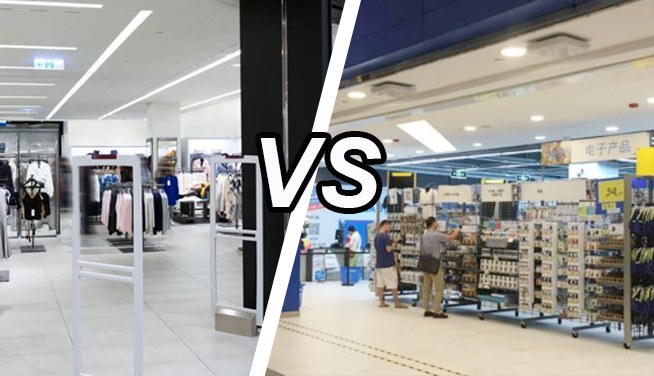
Shoppers pass freely through UHF RFID gate pedestals at a retail store entrance.
1. Three Technology Trends for RFID Gates in 2026
1.1 From "Passive Alarming" to "Active Sensing": AI Redefines Gate Capabilities
The core logic of traditional gates is "signal detected - determine presence - trigger alarm," with no understanding of movement direction, dwell trajectories or dense foot traffic. The new generation of RFID gates in 2026 achieves a qualitative leap through the deep fusion of edge AI algorithms and hardware:
|
Capability
|
Traditional gates (2019-2024)
|
2026 new-generation gates (AI + RFID)
|
|
Theft detection
|
Tag presence alarm
|
Item-level precise identification + intelligent anti-theft linkage
|
|
Direction judgment
|
Cannot distinguish entry/exit
|
AI trajectory analysis accurately distinguishes entering / exiting / passing by
|
|
False-alarm handling
|
Fixed signal threshold, easily disturbed
|
AI adaptive filtering; interference immunity improved by 80%
|
|
Data analysis
|
Only alarm records
|
Item traffic frequency, dwell time, conversion heatmaps
|
|
System integration
|
Runs in isolation
|
Seamless data loop with POS, WMS, ERP and video surveillance
|
BOWEI's view: when evaluating products, prioritize devices with a built-in AI inference unit that can complete trajectory judgment locally instead of relying on secondary cloud processing. Low latency and high reliability are the baseline requirements for gates in 2026.
1.2 RFID + EAS Fusion: One Deployment, Dual Value
The EAS (Electronic Article Surveillance) function bit in the ISO 18000-6C protocol lets an RFID tag serve simultaneously as an anti-theft trigger and a unique item identity:
-
Unpaid items: EAS bit is ON - passing the gate triggers an audible/visual alarm and reports the tag ID;
-
Paid items: the POS system automatically turns the EAS bit OFF - normal passage, no alarm;
-
Reusable mode: the bit can be rewritten repeatedly, so beyond anti-theft the tag continues to serve daily inventory counting and traceability.
This means enterprises no longer need to purchase RFID counting equipment and EAS security gates separately. One system covers both essential needs, cutting total cost by 30%-50%.
1.3 Edge AI Becomes Standard: Intelligence Moves onto the Device
The core breakthrough of 2026 is moving AI inference down to the reader or edge gateway. Devices are no longer "passive tag ID readers" but can judge autonomously, respond in real time and self-correct anomalies. Examples:
-
Recognizing multiple items in a shopping cart passing together, avoiding alarm after alarm;
-
Distinguishing "holding an item near the gate" from "actually taking it out," reducing false alarms;
-
Automatically adjusting receiver sensitivity based on environmental noise to maintain a stable read rate.
When evaluating vendors, ask explicitly: does the AI run on the device or in the cloud? On-device AI is what guarantees long-term stability.
2. Core Components and How to Select Them
A complete RFID gate system consists of six components. The choice of each one directly affects the final result:
|
Component
|
Function
|
2026 selection criteria
|
|
Gate reader
|
Transmits RF signals, parses tag data
|
Port count (4/8/16), max output power (at least 30 dBm), on-device AI support, protocol compatibility (ISO 18000-6C / EPC Gen2)
|
|
Gate antenna
|
Forms the precise identification field
|
Polarization (circular is mandatory), beam width (narrow preferred), gain (6-9 dBi), protection rating
|
|
RFID tags
|
Attached to products/assets
|
Frequency match (UHF), material adaptability (metal/liquid tolerant), size and mounting, EAS bit support
|
|
Audible/visual alarm module
|
Alerts staff
|
Adjustable volume, multi-color indicator, linkage with surveillance cameras
|
|
Management software platform
|
Data processing, reporting, alerting
|
Multi-store/multi-warehouse centralized management, richness of APIs, BI dashboards
|
|
Edge server / middleware
|
Data caching and forwarding
|
Concurrency (200+ tags/second), offline buffering and resume
|
3. Six Core Selection Metrics (with Practical Advice)
3.1 Read Accuracy: What the Numbers Really Mean
|
Metric
|
Baseline
|
Good
|
BOWEI measured
|
|
Read accuracy
|
95% or higher
|
99.5% or higher
|
99.7% (standard gate environment)
|
|
False-alarm rate
|
5% or lower
|
0.3% or lower
|
0.2% (AI filtering on)
|
|
Miss rate
|
3% or lower
|
0.5% or lower
|
0.4%
|
|
Simultaneous tags
|
50+
|
100+
|
200+
|
Key reminder: accuracy is not just a hardware spec - it depends heavily on antenna deployment and on-site tuning. Excellent hardware plus poor installation equals low accuracy. So evaluate not only the product datasheet but also whether the vendor provides site surveys, antenna layout simulation, installation, commissioning and after-sales optimization. BOWEI provides free on-site signal simulation and deployment guidance to turn paper specifications into real-world results.
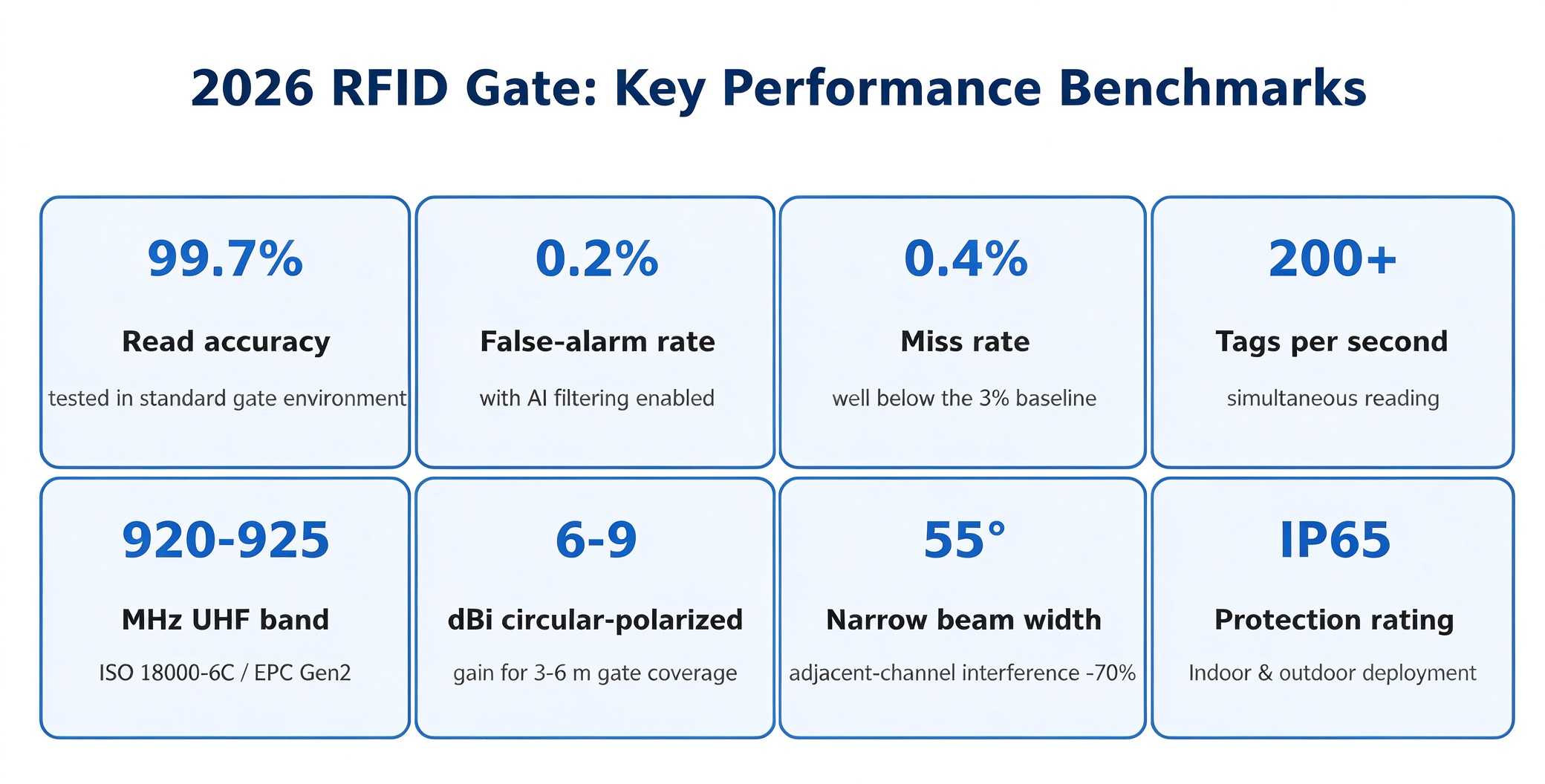
Key performance benchmarks of a 2026 RFID gate: 99.7% read accuracy, 0.2% false alarms, 200+ tags per second, IP65 protection.
3.2 Frequency and Protocol: UHF Is the Undisputed Mainstream
|
Band
|
Protocol
|
Typical regulations
|
Use case
|
2026 recommendation
|
|
UHF
|
ISO 18000-6C / EPC Gen2
|
China 920-925 MHz; EU 865-868 MHz; US 902-928 MHz
|
Long-range gates (1-6 m), fast batch reading
|
Strongly recommended
|
|
HF
|
ISO 15693 / ISO 18000-3
|
13.56 MHz worldwide
|
Very close range (under 0.5 m), single-book/library identification
|
Situational only
|
Conclusion: except for special short-range scenarios, UHF RFID gates are the clear first choice in 2026, balancing read distance, multi-tag throughput and future scalability.
3.3 Polarization: Circular Is Non-Negotiable
At gate scenarios, products in shopping bags, carts or on people are randomly oriented (folded clothing, flipped cartons). With a linearly polarized antenna, a tag rotated 90 degrees can drop the signal to zero and cause missed reads. Circularly polarized antennas respond stably to tags at any orientation and are the foundation of high read accuracy.
BOWEI recommends: all gate antennas should use circular polarization, with axial ratio optimized under narrow-beam conditions to eliminate dead zones in the coverage area.
3.4 Beam Width and Gain: Narrow Beam Is the Soul of a Gate
In apparel stores, retail aisles and warehouse entrances, the biggest fear is adjacent channels interfering with each other. Wide-beam antennas cover more area but easily misread tags outside the channel, mixing up data between lanes.
|
Dimension
|
Recommended
|
Why
|
|
Polarization
|
Circular (mandatory)
|
Handles any product orientation
|
|
Beam width
|
Narrow (40-60 degrees)
|
Locks onto the channel boundary; adjacent-channel interference down 70%
|
|
Gain
|
6-9 dBic
|
Balances read distance (3-6 m) with uniform coverage
|
|
Mounting
|
Ceiling / side mount
|
Ceiling mount avoids human blocking, uses zero floor space, looks clean
|
BOWEI's BRA-08 narrow-beam circularly polarized antenna is designed specifically for gate channels: 55-degree beam width, effectively isolating adjacent lanes, already verified across thousands of stores.
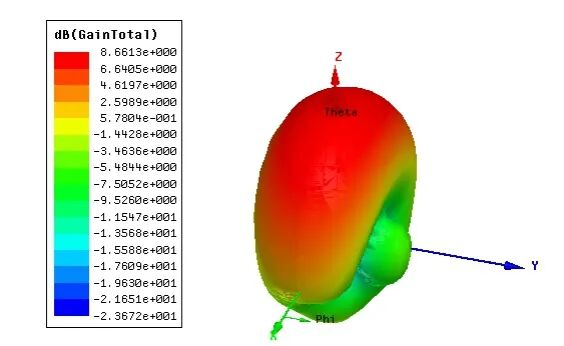
Simulated radiation pattern of a gate antenna (dB): energy concentrated in a controlled lobe toward the passage.
3.5 Protection Rating and Environmental Adaptability
|
Environment
|
Recommended rating
|
Special requirements
|
|
Retail stores / showrooms
|
IP54
|
Stylish appearance, low noise, discreet installation
|
|
Outdoor logistics passages
|
IP65+
|
Waterproof, dustproof, wide temperature (-20 to 60 degrees C)
|
|
Industrial workshops
|
IP65
|
Vibration resistant, oil-stain resistant, metal-reflection tolerant
|
|
Cleanrooms / healthcare
|
IP65
|
Ceiling mount, no floor space, easy to clean
|

A ceiling-mounted RFID antenna above a warehouse outbound corridor: zero floor space, full-coverage detection.
3.6 System Integration: The Ceiling of Data Value
An RFID gate in 2026 should never be an information island. A quality system should natively support fast connection with:
-
POS: automatically clears the EAS bit at checkout, no manual action;
-
WMS: real-time inventory in/out records, automatic replenishment alerts;
-
ERP: asset check-out/check-in automatically logged, full lifecycle traceable;
-
Video surveillance: camera snapshot linked the moment an alarm triggers, preserving evidence;
-
Enterprise messaging (WeCom / DingTalk): abnormal events pushed to managers' phones in real time.
When selecting, be sure to confirm that the vendor provides standardized API documentation and proven integration cases with mainstream ERP/WMS platforms.
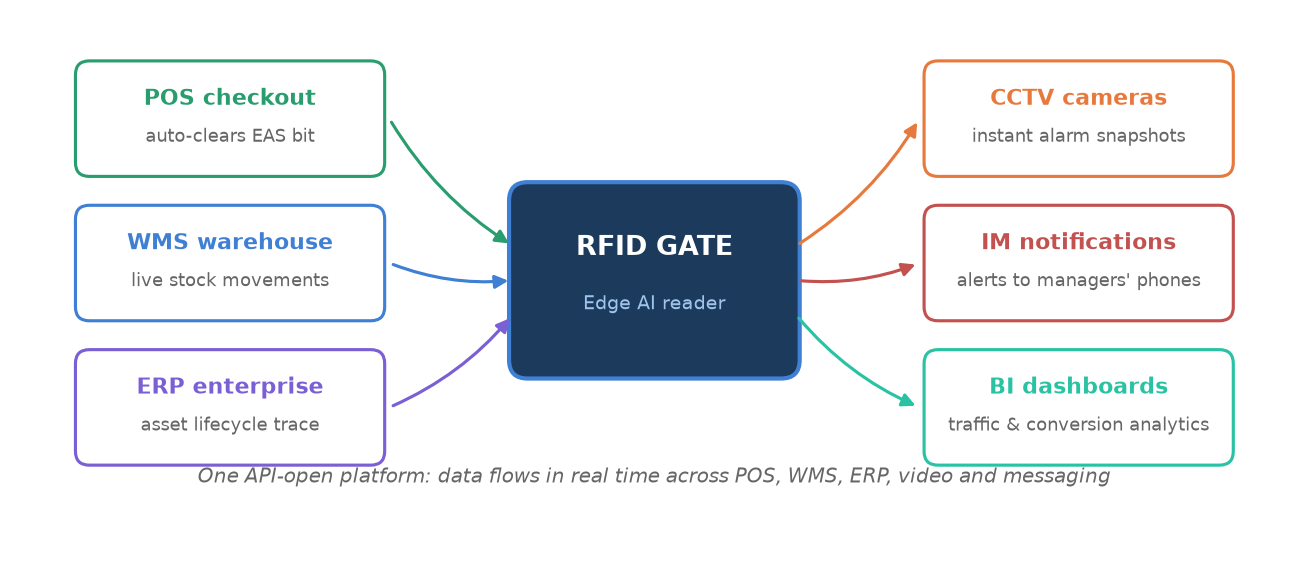
One API-open platform: the RFID gate shares data in real time with POS, WMS, ERP, CCTV and messaging tools.
4. FAQ (2026 Edition)
Q1: How much does an RFID gate system cost?
A: It depends on the application scenario, reader performance, tag volume and software features. A basic single-store retail configuration (gate + tags + handheld reader + standard software) costs roughly RMB 20,000 (about USD 2,800). A mid-size store/warehouse (antennas + WiFi reader + tags + handheld + custom integration) runs about RMB 30,000-100,000 (about USD 4,200-14,000). Large multi-channel fully integrated projects are quoted after a site survey. BOWEI offers free requirement assessment and quotation.
Q2: Can existing traditional EAS gates coexist with RFID gates?
A: Technically yes, but we strongly recommend upgrading directly to RFID gates. Running both systems means duplicate investment, double maintenance and fragmented data. An RFID gate delivers anti-theft + counting + traceability simultaneously, with a lower total cost of ownership.
Q3: What if the channel is wider than 3 meters?
A: The optimal width for a standard RFID gate is 1-2 meters. Beyond 3 meters, add antennas (e.g. 4- or 6-antenna arrays); beyond 5 meters, use zone deployment. BOWEI's multi-antenna phase-array technology adapts to ultra-wide channels with no blind zones.
Q4: Will metal shelving or metal door frames affect identification?
A: Metal is the main interference source for UHF RFID. Keep antennas at least 1 meter from metal, or use anti-metal tags and reflection-suppression antennas. BOWEI performs on-site electromagnetic environment testing before deployment, adjusting antenna angles and adding absorbing materials as needed.
Q5: How long does installation take?
A: A standard single channel (1-2 m wide): hardware installation about half a day, software configuration and commissioning about one day - 1 to 2 days total. Multi-channel or deep ERP/WMS integration projects usually finish in 3-5 days. BOWEI provides on-site installation plus remote technical support.
5. Conclusion: The Four Golden Rules for Buying an RFID Gate in 2026
|
Rule
|
Key point
|
|
Choose UHF
|
UHF is the 2026 mainstream for gates: long range, many tags, high speed
|
|
Circular polarization is mandatory
|
Product orientation is random; circular polarization is the foundation of stable reads
|
|
Narrow beam over wide
|
Narrow beams lock onto the channel, avoid adjacent-lane misreads, keep data clean
|
|
Integration beats hardware stacking
|
Hardware sets the floor; software integration sets the ceiling - choose a vendor with open APIs and proven integration experience
|
BOWEI Intelligent is a national high-tech enterprise with more than a decade of focus on UHF RFID antenna and reader R&D and manufacturing, offering a full line of gate antennas, readers and industry application software. From site surveys and solution design to product supply, installation, commissioning and after-sales support, we provide one-stop service and have helped more than 3,000 enterprises worldwide upgrade to intelligent sensing.
Ready to evaluate RFID gates for your business? Contact us for a free 2026 RFID gate selection assessment - and turn every entry and exit into a data asset.