Chain apparel brands in Guangdong have expanded noticeably fast in recent years, with shopping-mall and street stores opening at an ever higher density across the Pearl River Delta. But one problem keeps coming back: shrinkage.
According to data released by the China Chain Store & Franchise Association in 2025, the annual shrinkage rate of Chinese apparel stores runs as high as 3%-5%, and some fast-fashion brands exceed 8%. Traditional magnetic hard-tag gates alarm frequently, leaving staff exhausted; surveillance footage helps little for after-the-fact evidence. For chain brands opening new stores in Guangdong, choosing the anti-theft system has become a decision that deserves real attention.

RFID has become the new infrastructure of chain apparel retail - from the sales floor to the exit gate.
Why Traditional Anti-Theft Systems Are Increasingly Not Enough
Most apparel stores today still use EAS acoustic-magnetic systems, which trigger an alarm when a magnetic strip or hard tag passes the door. The technology is mature and cheap, but its weaknesses are obvious.
First, high false-alarm rates. Customers' phones, metal accessories, even merchandise from neighboring stores can trigger the alarm. Data shows traditional acoustic-magnetic gates can reach a false-alarm rate above 25% in metal-interference environments. Frequent false alarms hurt the customer experience and desensitize staff - so when a real theft happens, the reaction is slow.
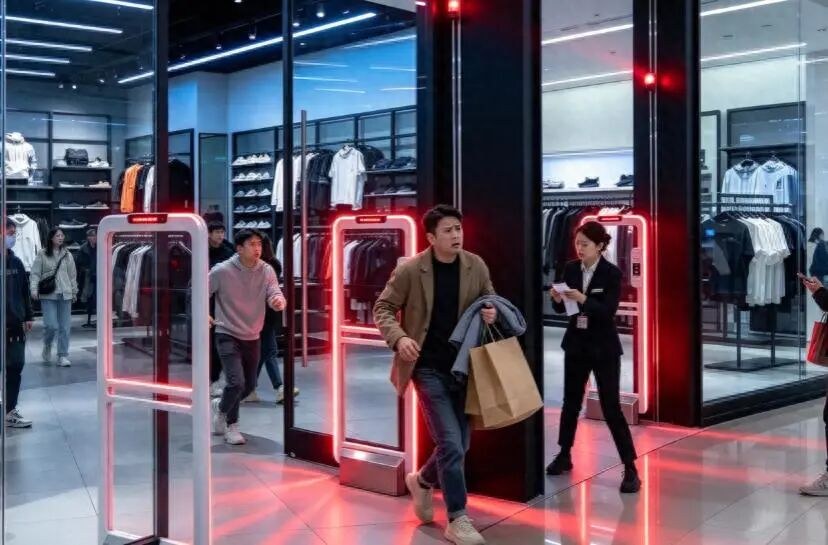
A familiar scene with EAS gates: alarm triggered, no idea which item or why.
Second, alarm only - no traceability. After an EAS alarm, staff only know that "something was not deactivated." They have no idea which product, which category, or what value. That makes inventory write-offs and shrinkage analysis very difficult.
Third, no protection against internal theft. Staff walking out with merchandise look the same as staff walking out empty-handed to an EAS system. The problem usually surfaces only at the next stocktake.
How RFID Anti-Theft Gates Actually Work
RFID gates work on a completely different logic. Every garment carries a UHF RFID tag in its hangtag or care label, programmed with a globally unique code mapped one-to-one to the product SKU. When the item passes the POS counter, the checkout system automatically rewrites the tag's security status; an unpaid item approaching the exit gate triggers an alarm immediately - together with a display of exactly which item it is.
The direct result: from "vague alarming" to "precise identification."

Every garment's hangtag carries a unique EPC code tied to the SKU.
On identification accuracy, RFID gates using AI algorithms and narrow-beam antennas can keep the false-alarm rate below 0.1%. Merchandise displayed near the gate, tags from the store next door, and items customers have already paid for - none of them interfere with the judgment.
On coverage, RFID enables managing people and goods together. With a ceiling antenna in the fitting room, every entry/exit of garments is automatically logged; swapping hangtags or hiding items in pockets triggers an alert. Staff corridors can be gated the same way, with abnormal take-outs pushed to managers' phones in real time.

A ceiling antenna above the fitting room logs every garment in and out automatically.
What Chain Brands Should Evaluate
For chain apparel stores in Guangdong selecting an RFID gate system, four dimensions deserve special attention.
Multi-store unified management. The system must not be single-store minded. Headquarters needs real-time access to every store's alarm records, shrinkage trends and abnormal events. Gate devices supporting cloud protocols such as MQTT let HQ configure parameters remotely and upgrade algorithms uniformly - no per-store manual work.
Installation adaptability. Mall stores vary widely: limited ceiling height, entrance widths approaching 3 meters, or stores that cannot shut down for long construction. Gate equipment should support vertical, ceiling and in-floor mounting, ideally deployed within the after-hours window. A mature solution today can fully install a store of about 100 square meters in one day.
Integration with existing systems. Most chain brands already run ERP or POS systems; the RFID gate must connect with them so inventory, sales and loss-prevention data sync automatically. Confirm the supplier has mature APIs and proven integration experience - otherwise the project risks becoming an unfinished integration.
Tag compatibility. The gate must be compatible with mainstream UHF RFID tags: hangtags, care labels and woven labels. If the brand already uses RFID tags at the supply-chain end, the gate should reuse them directly - no need to change the tag program.

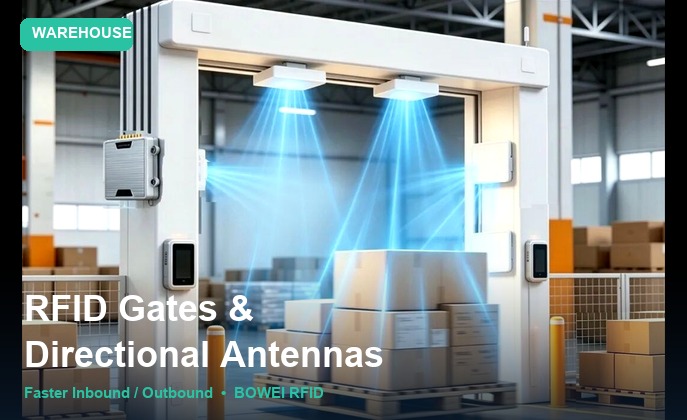
Ceiling-mounted gates project a defined detection beam - no pedestals, no blocked entrances.
The Pre-Deployment Checklist
Once the project is approved, confirm these items before the vendor arrives on site:
-
Store floor plan and entrance dimensions: confirm gate positions, channel width and ceiling height, and whether ceiling or vertical mounting fits.
-
Inventory of existing IT systems: map the interfaces of ERP, POS and membership systems, and define the data-integration requirements.
-
Tag selection confirmation: confirm the right tag form for each product category (hangtag / care label / woven label) and that tag read performance meets gate requirements.
-
Construction time window: agree with the mall on after-hours construction periods, and schedule equipment arrival and commissioning.
-
Clear acceptance criteria: agree with the supplier in advance on target read accuracy, false-alarm rate and miss rate.
The better this preparation, the smoother the implementation. Industry experience shows that over 75% of identification problems after go-live come not from the equipment itself, but from improper installation or insufficient upfront planning.
BOWEI: A Mature Choice for Chain Apparel RFID Gates
For chain apparel RFID projects in South China, BOWEI is a supplier worth serious evaluation. As a national high-tech enterprise and a leading global RFID hardware provider, BOWEI has more than 15 years of technology accumulation in RFID antennas and gate readers, with products widely used in retail, archives, libraries and logistics.
For the apparel chain scenario, two capabilities stand out:
Phased-array radar + AI algorithms. BOWEI combines phased-array beamforming with RFID gates, filtering out invalid interference through precise multi-beam positioning. In a channel as wide as 2.2 meters, the system simultaneously tracks and accurately judges the direction of more than 50 fast-moving tags, with a multi-tag read rate above 99% - no missed reads or direction errors even during morning rush hours.
Invisible ceiling deployment. BOWEI's BRD-series ceiling gates support mounting heights of 2 to 5 meters, with a single unit covering a main aisle of 2.5-3 meters. All hardware hides above the suspended ceiling - no pedestals or fences at the store entrance. For brands that care about store aesthetics, this is a very practical plus.

BRD-series ceiling gate: the detection beam covers the main aisle while the hardware stays invisible.
If your new project is about to start, remember: the key to choosing an RFID anti-theft gate is not comparing prices - it is whether the solution runs stably in a real store environment. BOWEI has mature reference cases in apparel retail and provides complete hardware support from tag selection to gate deployment and system integration.
Evaluating RFID gates for your chain? Contact BOWEI for a free site assessment and deployment plan.